

The metric gym owners ignore until it hurts.
Most gym owners think they have a marketing problem.
They don’t.
They have a retention problem dressed up as a marketing problem. That’s why the ad spend keeps climbing. That’s why the funnel never feels stable. That’s why the gym looks busy but doesn’t actually feel like it’s growing.
The metric that exposes the truth is churn rate — and most operators don’t track it until the math finally catches up with them.
A gym can look busy, generate decent revenue, have strong social media, run successful promotions, produce real transformations — and still slowly bleed itself to death financially because of high churn.
What churn rate actually is
Churn rate is the percentage of clients who stop doing business with you in a given window.
In a gym, churn includes:
- Membership cancellations
- Expired memberships not renewed
- Personal training clients who quietly stop
- Online coaching clients who disappear
- Failed payment clients who never come back
- Clients who emotionally checked out long before the cancellation
Churn rate measures how fast your business leaks clients.
This matters because gyms are recurring-revenue businesses. Profitability isn’t determined by how many people sign up this month. It’s determined by how long they stay, how much they spend, and whether they become part of the culture instead of just renting space in your schedule.
A gym with moderate lead flow and excellent retention will outperform a gym with aggressive marketing and terrible retention. Every time.
How to calculate it
The formula is simple:
Churn Rate = (Clients lost during the period ÷ Clients at start of period) × 100
Example. You start the month with 300 members. During the month, 21 cancel or fail to renew.
21 ÷ 300 × 100 = 7%
7% of your client base disappeared in a single month.
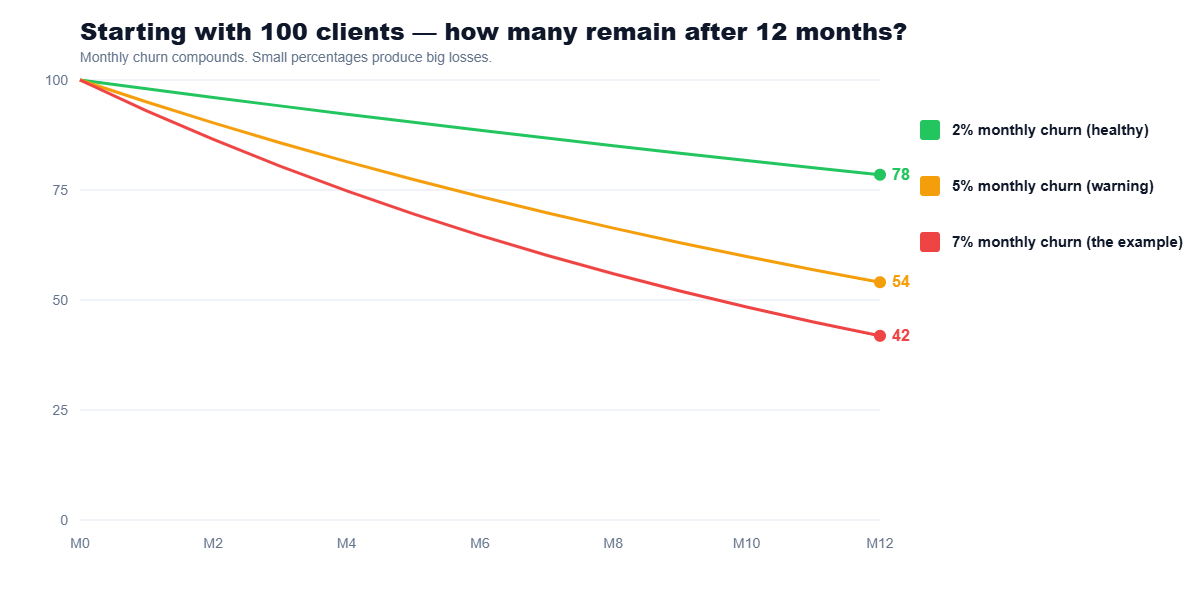
Most owners shrug at that number. They shouldn’t. Monthly churn compounds. At 7% monthly churn, you’ll have replaced more than half your entire member base in a year — just to stay even.
Why most owners underestimate this
Acquisition feels exciting. New clients create emotional momentum. Retention problems are quiet.
They happen slowly: attendance drops, engagement fades, clients disconnect, payments fail, members stop identifying with the culture. Then one day the owner realizes revenue feels inconsistent, member count hasn’t really grown, marketing costs keep rising, staff feels exhausted, profit margins feel thinner every year.
High churn creates hidden operational stress throughout the entire business:
- Revenue instability
- Increased advertising dependency
- Lower profit margins
- Higher acquisition costs
- Increased staff workload
- Weak community culture
- Reduced referrals
- Lower long-term business valuation
The business stops building. It just replaces.
What it actually costs you to lose a client
This is where the math gets ugly.
When a client leaves, you’re not just losing one membership payment. You’re losing future recurring revenue, referral opportunities, testimonials, social proof, community energy, and long-term lifetime value.
To understand the full damage, you have to know your Client Acquisition Cost (CAC). Every gym owner should know this number.
CAC includes paid ads, content creation, CRM software, sales staff time, follow-up systems, promotions, lead nurturing, trial offers, event costs, and referral incentives.
Example. You spend $4,000 a month on marketing. You acquire 25 new members.
$4,000 ÷ 25 = $160 cost to acquire each member
Now imagine that member pays $149/month and cancels after 2 months. Total gross revenue: $298. Before payroll, rent, utilities, software, taxes, equipment maintenance, insurance, and operating costs — you’ve already burned most of your margin.
This is why so many gyms stay busy and still feel financially stressed. The math is fighting you.
Busy vs. profitable
Some gyms operate with extremely high churn but hide it with aggressive marketing. The gym looks successful from outside — new faces, active social, constant promotions. But inside, members don’t stay, coaches restart relationships every quarter, systems become reactive, culture weakens, revenue becomes unpredictable. The owner feels trapped on a treadmill.
Gym A (high churn): 40 new members per month, 35 cancellations per month, heavy ad spend, constant promotions, weak culture, exhausted staff. Net gain: +5 members.
Gym B (low churn): 18 new members per month, 5 cancellations per month, strong onboarding, real culture, high accountability. Net gain: +13 members.
Gym B is more profitable with less advertising, less stress, less chaos, better staff morale, and a better client experience. Retention compounds. Acquisition just refills the bucket.
Monthly churn analysis is non-negotiable
Every serious gym owner should review churn monthly. Not emotionally. Not casually. Systematically.
Track:
- Total cancellations
- Failed payments
- Average client lifespan
- Membership length
- Coaching retention
- Retention by coach
- Retention by offer
- Retention by acquisition source
Patterns emerge. You start identifying weak onboarding, coaches with poor retention, offers that attract low-quality leads, seasonal patterns, pricing issues, communication failures, accountability gaps.
This becomes operational intelligence — the kind that actually informs decisions, instead of decisions made by gut feel and Instagram screenshots.
The first 30 days decide everything
Most retention problems start within the first 30 days. That’s where clients decide whether they belong, whether they feel supported, whether they trust the process, whether they identify with the culture, whether they feel seen.
The strongest gyms manufacture all of that on purpose: community, identity, accountability, structure, momentum, personal connection. People rarely leave places where they feel connected.
Questions to ask every month
- What is our exact churn rate?
- Is it improving or worsening?
- Which clients leave fastest?
- Which acquisition channels retain best?
- What’s our average client lifespan?
- What’s our average lifetime value?
- Which coaches retain best?
- What offers attract committed clients?
- How much revenue are we losing monthly through churn?
- How much extra marketing are we forced to buy because of churn?
If you can’t answer these clearly, you’re operating partially blind.
Why this matters more when the economy tightens
When the economy contracts: advertising gets more expensive, consumers become cautious, competition increases, price sensitivity rises.
Gyms with high churn struggle first because they depend on constant acquisition. Gyms with strong retention survive far more effectively — revenue stays predictable, communities stay strong, referrals increase, trust already exists. Retention creates stability when nothing else does.
The bottom line
Most gym owners spend too much time trying to get more people in the door. Experienced operators understand the real game: keeping the right people long enough to create results, relationships, community, recurring revenue, referrals, and long-term stability.
Growth isn’t about how many people walk into your gym. It’s about how many decide they never want to leave.
When you actually know your churn rate, you stop guessing. You stop operating emotionally. You stop blindly throwing money at marketing. You start making intelligent business decisions.
The gyms that dominate long term aren’t the ones with the loudest marketing. They’re the ones with the strongest retention systems.
— Dave