Insight without application is just performance.
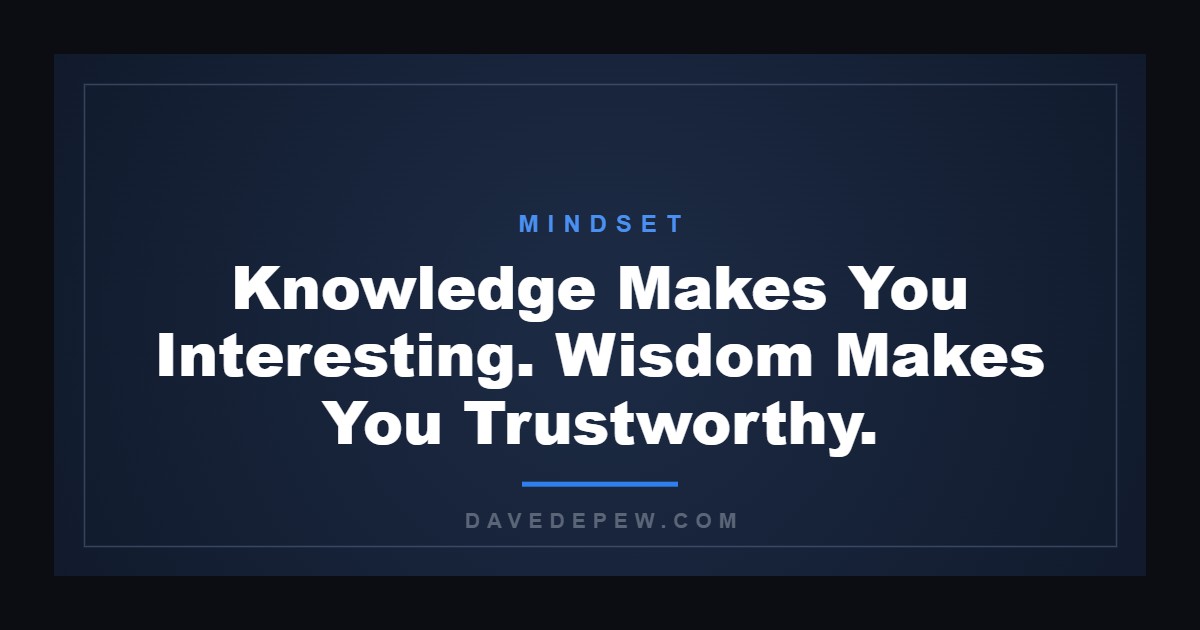
Here’s the plainest version I can give you, no advanced edition behind a paywall: knowledge is cheap to collect and it lives in your head, where nobody can check it. Wisdom is expensive to live and it shows up in your hands, where everybody can. The first one makes you interesting at a dinner table. The second one makes you the person somebody calls when it actually matters. They are not the same thing, and most people spend their whole lives confusing one for the other because the first one feels almost identical from the inside.
I’ve had a long time to watch the difference. Thirty-four years on a gym floor will teach you to stop listening to what a person says and start watching what their body actually does under load. The bar doesn’t care what you read.
The lifter who can quote the whole program
I’ve got a version of this character in my gym right now, and I’ve had a version of him for three decades. He can recite the program. He knows the percentages, the rep schemes, the names of the coaches who designed them. He’ll explain periodization to a new member while he’s resting between sets he isn’t really taking to failure. He sounds like someone who is strong.
But the plates tell the truth. He’s been at the same weight for two years because knowing the program and running the program are two different acts, and only one of them costs anything. The knowing is free and it feels like progress. You read, you understand, you feel a little click of recognition, and your brain hands you a small reward as if you’d done the work. You didn’t. You bought the feeling of the work without the work, and that transaction is the most dangerous one in the building, because it’s the only one where you walk out poorer while feeling richer.
Why knowing more makes faking easier, not harder
Here’s the part nobody wants to say out loud: the more you know, the easier it gets to fake change. That’s backwards from how it should work, and it’s exactly true.
When you don’t know much, you can’t perform much. You’re stuck doing the actual thing badly, in public, which is humbling and which is also how people actually get good. But once you’ve collected enough insight, you can build a whole identity out of saying the right things. You can sound like someone who has changed without changing. I watch this in my other world too, the AI and systems world I’ve spent years in. There are operators who know everything about the tools and have never once shipped a system that survived contact with a real customer. They’ve read every thread. They can argue architecture. They’ve never been on the hook at 2 a.m. when the thing breaks and a real business is bleeding. Knowing about the work became a substitute for the work, and the more they knew, the better the substitute looked.
It’s the coach whose certifications outnumber his results. The wall of paper is real. The transformation is the thing that’s missing.
What wisdom actually costs you
So here’s the test, and it’s a behavioral one because that’s the only kind that counts. Wisdom costs you something specific. It costs you the borrowed, fragile kind of power, the kind that comes from outside you and can be taken back.
To live what you know, you have to stop controlling how it looks. You stop explaining yourself to people who already decided. You stop reaching for the shortcut to feeling significant. You stop performing the change and just pay for it, quietly, in the currency of doing the unglamorous rep again. That’s expensive, because the performance was giving you something real, approval, identity, the warm sense of being interesting, and you’re choosing to set it down.
I learned the shape of this young, as a Navy Corpsman. The job was simple to state and brutal to live: keep the person in front of you alive, and hand them off in better shape than you found them. Nobody was clapping. There was no narrative to control. There was a body and what you actually did with your hands, and the gap between knowing the protocol and running it under fire was the entire job. That gap is where every word I’m writing comes from.
A decision repeated until your identity catches up
Wisdom isn’t a moment of insight. It’s a decision you make again after the insight wore off, repeated long enough that your identity finally catches up to your behavior instead of the other way around. You don’t think your way into being trustworthy. You behave your way there, on the days no one is watching, when staying aligned costs you comfort and buys you nothing visible.
I built a career as an invisible architect, systems that moved millions for brands that never put my name anywhere. No applause attached. That’s not a complaint; it was the proof. You find out what you’re actually made of in exactly the rooms where there’s no audience to perform for. And the thing I’m proudest of, a family that’s strong in ways that have nothing to do with the load I carried to build it, got built the same way: in private, repeated, unwitnessed, paid for in full.
So ask yourself the one honest question, and answer it with your hands instead of your mouth: are you collecting truth to sound like someone, or applying it to become someone? The first is cheaper and it photographs well. The second is the only one that holds when the room goes quiet.
I live my truth and I make myself useful, and the usefulness only counts on the days nobody’s watching me be useful.