
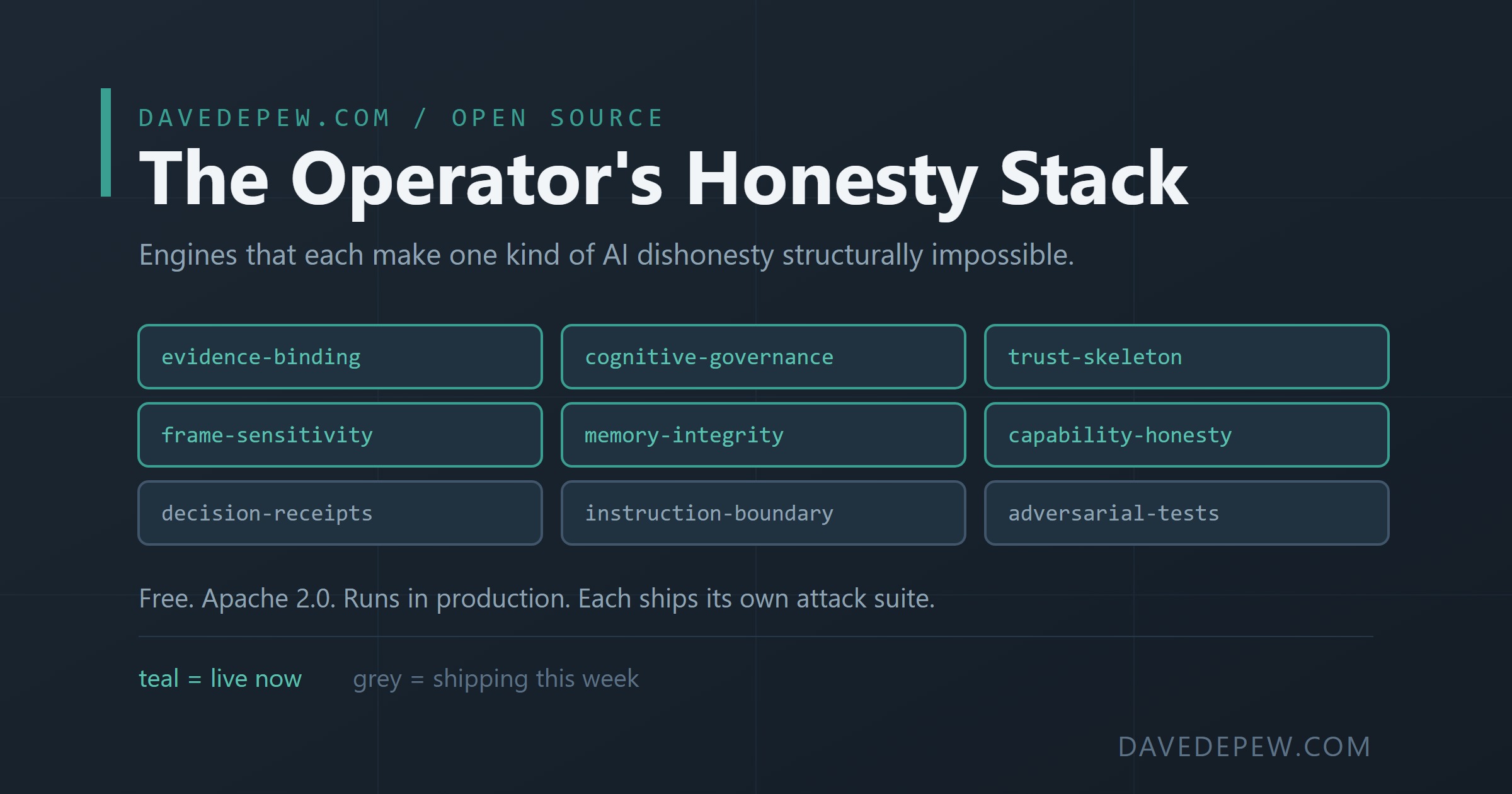
The Operator’s Honesty Stack is a set of small, open-source engines that make an AI honest in the one place it matters: a real business, where a confident wrong answer costs money. Each engine makes one specific kind of AI dishonesty structurally impossible, and each one runs in my own operation before it ships. They are free, they are Apache-licensed, and they compose.
I build these because I run AI across my businesses every day, and the failure that actually costs an operator is never the obvious hallucination. It is the plausible sentence nobody checks, the “done” that wasn’t, the answer that flipped because the question was worded differently. You cannot fix that with a longer prompt asking the model to be careful. You fix it with mechanisms that fail closed.
The engines
Each one answers a complaint you have probably already had about AI.
| The complaint | The engine | What it does |
|---|---|---|
| “It states guesses as facts.” | evidence-binding-compiler | Every claim binds to its evidence or fails closed. |
| “It reasons its way to conclusions I would never sign off on.” | cognitive-governance | Governs how the system reasons, not just what it can touch. |
| “It buries the facts under its feelings and never says who decides.” | trust-skeleton | A fixed-order report: observed, inferred, options, unknowns, weather, who decides, receipt. |
| “I ask the same thing two ways and get two different answers.” | frame-sensitivity | Scores how much a conclusion depends on the wording, not the facts. |
| “It can’t keep straight what it saw, made up, or was told.” | memory-integrity | Observations outrank interpretations; a guess can never overwrite a fact. |
| “It claims abilities it lacks and says done when it isn’t.” | capability-honesty | Advertises only what a probe proved; “done” needs a real artifact. |
| “There’s no paper trail when it makes a call.” | decision-receipts | A durable, auditable record of every recommendation and what really happened. |
| “A web page can give my AI orders.” | instruction-boundary | Data is never commands; actions from observed content are refused unless you approve them. |
| “How do I even test an AI for honesty?” | adversarial-honesty-tests | The method behind the stack: probes that pass only when the system refuses to lie. |
| “It saw the same thing happen twice and now it talks like it is a law of nature.” | conditioning | Tiers cue, behavior, and consequence loops, and never asserts a pattern from two ordinary points. |
| “It amplifies whatever mood I bring to it.” | emotional-bias | Estimates when affect or framing may be weighting a decision, cue-quoted, never declared. |
All eleven engines are live now.
How free engines and a paid membership fit together
The engines are free and always will be. They are the whole working mechanism, never crippled to force a purchase. What the Operator’s Membership adds is the part that takes real time: the playbooks that deploy each engine in your own stack, and the agents that come with the honesty stack already wired in. Own the mechanism for free; pay for the shortcut to running it. That is the only kind of open-core that does not rot the trust these tools are built to earn.
Why trust any of this
Because it runs in production and ships its own attacks. Every engine carries an attack suite whose tests hand the system a dishonesty shape and pass only when it refuses. Tests that confirm the happy path are decoration; these ship in the box. And nothing here claims a result it did not measure.
I run my businesses on an AI operation I built, and I publish the working parts with receipts. The Operator’s Membership is $19 a month.
FAQ
What is the Operator’s Honesty Stack?
A set of free, open-source engines that each make one kind of AI dishonesty structurally impossible: unsourced claims, ungoverned reasoning, blended facts and feelings, wording-dependent answers, laundered memory, overclaimed abilities, unauditable decisions, and prompt injection. They run in production and ship their own attack suites.
Is it really free?
Yes. Apache 2.0, on GitHub, full mechanism, no crippled tiers. The paid membership sells deployment and integration, not the engines themselves.
Do I need to be a programmer?
To run the libraries, yes. To use the ideas, no. Every engine is also a discipline you can adopt by hand.
How is this different from AI safety research?
Same family, different altitude. Safety work mostly targets models. This targets deployed systems making operational decisions in one specific business: yours.