Most people are confidently wrong about AI.
Not a little wrong. Wrong in two opposite directions at the same time.
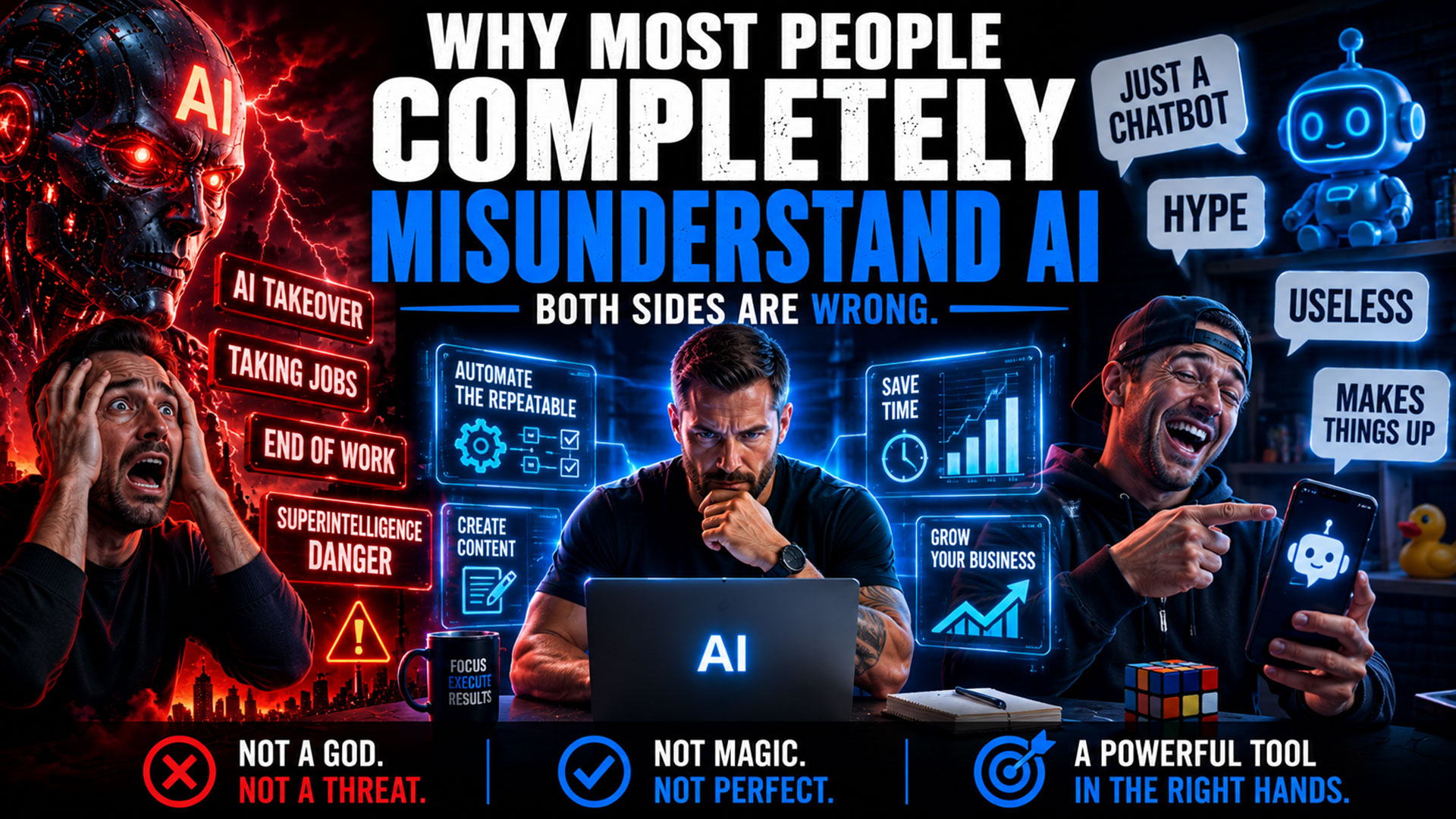
One group thinks it is a thinking machine that is about to wake up, take the jobs, and maybe end the world. The other group thinks it is a toy. A party trick. A chatbot that makes things up and cannot be trusted with anything real.
Both pictures are wrong. And both are expensive, because what you believe AI is decides how you use it. Get the picture wrong and you will either fear a tool you should be using or dismiss a tool that is already changing your competitors’ businesses.
This article is about getting the picture right. Not the technical details. The plain, working understanding of what this thing actually is, so you can use it like an operator instead of arguing about it like a spectator.
The Two Wrong Pictures
The first wrong picture comes from movies.
For fifty years, the story we were told about artificial intelligence was a machine that thinks, feels, wants, and eventually turns on us. A mind in a box. So when something arrived that could hold a conversation, a lot of people reached for the only frame they had. They assumed the conversation meant a mind was behind it.
It does not. More on that in a minute.
The second wrong picture is the backlash to the first. People tried an AI tool once, it made a confident mistake, and they decided the whole thing was overblown. A liar. A toy. Not ready.
Here is the trap. Both groups stop learning at the exact moment they form their opinion. The believer waits for the machine to wake up. The skeptic waits to be proven right. Neither one does the only thing that teaches you what AI actually is, which is to use it on real work, repeatedly, and watch where it is strong and where it is weak.
What AI Actually Is
Strip away the movies and the hype, and modern AI is something much simpler to describe.
It is a prediction machine.
It was trained by reading an enormous amount of human writing. Books, articles, conversations, code, almost everything. From all of that reading it learned one skill extremely well. Given some text, it can predict what words should come next in a way that sounds right.
That is the whole trick. It is not recalling facts from a database. It is not looking things up. It is predicting the most likely next piece of language, one step at a time, based on everything it has seen before.
This sounds too simple to be useful. It is not. It turns out that if you get good enough at predicting language, you can do a staggering range of useful things. You can draft an email, because you have seen millions of emails. You can summarize a document, because you have seen millions of summaries. You can answer a question, because you have seen the shape of millions of answers.
It looks like thinking. It is closer to the most well-read assistant in the world, one who has read everything and remembers the patterns, but who is guessing every word as they go.
A Way To Picture It
Here is the picture that will serve you.
Imagine an assistant who has read more than any human ever could. Every book, every manual, every article in your industry and a thousand others.
Now imagine that this assistant is fast, tireless, and eager. They will take any task you give them and produce something immediately.
And imagine one more thing. This assistant has no real understanding of the world, no memory of your business unless you tell them, and no ability to know when they are wrong. They are pattern-matching at incredible speed and confidence, whether the pattern fits or not.
That is what you are working with. Not a mind. Not a toy. A fast, well-read, confident assistant who needs direction and checking. Once you see it that way, both wrong pictures fall apart, and you start using it correctly.
Why The Misunderstanding Is Expensive
The wrong pictures are not harmless. Each one costs you in a specific way.
If you believe AI is a thinking machine, you over-trust it. You take its confident answer as truth. You let it make decisions it has no business making. And the first time it states something false with total confidence, you get burned, and you swing all the way to the other wrong picture.
If you believe AI is a useless toy, you under-use it. You leave it sitting there while the operator down the street quietly cuts hours out of their week with it. You pay full price for work that now has a discount, and you call it caution.
The correct picture sits between the two, and it is the only one that makes you money. It says this is a capable tool with real strengths and real limits. Use it for what it is good at. Check it where it is weak. Do not worship it and do not dismiss it.
What This Looks Like In Practice
Picture an operator who just discovered AI and believes the first wrong picture.
They are impressed. They ask it to analyze their numbers and tell them what to do. It produces a clean, confident answer full of specific figures. They act on it. Later they find out half the figures were invented, because the tool did not have their real numbers and predicted plausible ones instead. They feel betrayed. They quit using it entirely.
Now they hold the second wrong picture. For the next year they do everything by hand, telling anyone who asks that AI is not ready, while a competitor uses the same tool correctly. The competitor never once asks it to invent facts. They only ever ask it to draft, summarize, and rewrite. The competitor saves ten hours a week. The burned operator saves nothing and feels wise about it.
One tool. Two wrong pictures. One operator, who managed to hold both and lose twice.
The fix was never a better tool. It was a correct understanding of what the tool is.
How To Tell Strength From Weakness
You do not need a manual for this. You need a simple rule.
AI is strong when the work is about language and patterns, and when being roughly right fast is more useful than being perfectly right slowly. Drafting, summarizing, rewriting, brainstorming, explaining, organizing. The first version of almost anything.
AI is weak when the work requires being certain, current, or accountable. Hard facts it might invent. Recent events it never saw. Math it can fumble. Anything where a confident wrong answer does real damage.
So the operator move is to let it do the first eighty percent of the language work, fast, and to keep the final judgment for yourself. It drafts. You decide. That division of labor is the entire skill, and it comes straight out of understanding what AI actually is.
Where To Begin
This week, run one small experiment that will teach you more than any article.
Give an AI tool two tasks on purpose. One it should be good at, and one it should be bad at.
For the first, ask it to rewrite a rough paragraph you already have, or to summarize a long email thread. Watch how good it is at the language work.
For the second, ask it a specific factual question about something recent in your industry, or something only your business would know. Watch it either admit it does not know, or, worse, make up a confident answer that is wrong.
Do both in the same sitting. Feel the difference. That contrast, the strength and the limit side by side, is the real understanding of AI. Not the movie version. Not the hype version. The working version you just saw with your own eyes.
That is what most people never do. They form an opinion and stop. You are going to use it and learn. That is the whole difference between a spectator and an operator.