
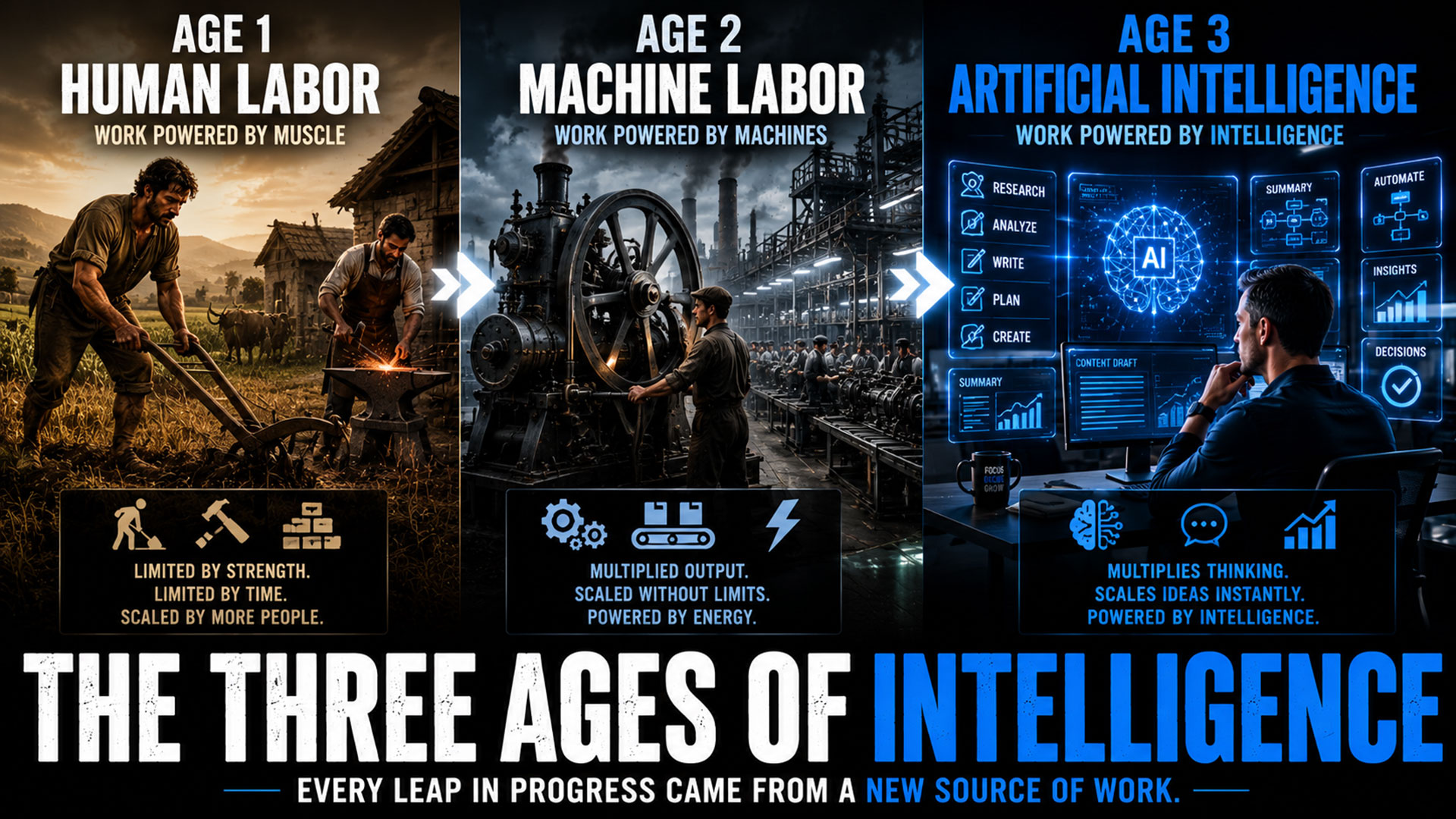
Every leap in human progress came from the same move.
We found a new source of work, and the people who adopted it early pulled away from the people who did not.
There have been three of these. Three ages, each defined by where the work came from. Human labor. Machine labor. And now, artificial intelligence. We are at the start of the third one, and the pattern from the first two tells you almost everything you need to know about what to do.
This article is that pattern. Not history for its own sake. History as a map, because we have stood exactly here before, twice, and we know what happened to the people who waited.
The First Age: Human Labor
For most of human history, work meant muscle.
If you wanted a field plowed, a wall built, a load carried, or a thing made, it happened because a human or an animal physically did it. Output was tied directly to bodies and hours. More work meant more people, more time, or more strain.
This put a hard ceiling on what any one person could do. A single farmer could only work so much land. A single craftsman could only make so many goods. Wealth and capability scaled with how many bodies you could put on the problem, which is why for thousands of years the size of your labor force was the size of your power.
The ceiling was muscle. Everyone lived under it. Nobody questioned it, because there had never been anything else.
The Second Age: Machine Labor
Then, a few hundred years ago, that ceiling broke.
Steam, then engines, then electricity. Suddenly work did not have to come from a body. A machine could do the lifting, the moving, the making, and it could do it at a scale no number of humans could match. One person with a machine could out-produce a hundred people without one.
This is the part worth sitting with. The machines did not just help. They reset the math of who could compete. The weaver who adopted the power loom did not beat the hand-weaver by a little. They buried them. Not because they were smarter or worked harder. Because they had a new source of work and the other person did not.
Whole industries, towns, and fortunes were built by people who saw the new labor source early and moved. Whole industries, towns, and fortunes were lost by people who were sure the old way was good enough. Both groups worked hard. Only one group was multiplied.
The ceiling moved from muscle to machine. And the people who climbed onto the machine left everyone else behind.
The Third Age: Artificial Intelligence
Here is what is different now, and why this article exists.
Every machine in the second age multiplied muscle. It did physical work. It moved, lifted, spun, and stamped. What it could never do was the thinking work. The deciding, writing, planning, analyzing, and communicating. That stayed with humans. That stayed under the old ceiling.
Artificial intelligence is the first source of work that multiplies the mind instead of the muscle.
For the first time, the thinking-and-writing labor that used to require a person can be done, in part, by a machine. The draft, the summary, the analysis, the plan, the reply. The work that lived in people’s heads and ate their hours is now work a machine can take a first pass at.
That is not a small upgrade to the second age. It is a new age. The first one that touches the kind of work that knowledge businesses actually run on. If your business produces thinking, writing, and decisions, the third age is aimed directly at you.
What Each Age Did To The People In It
The pattern repeats with almost boring reliability.
In every age, the new source of work showed up. It was imperfect at first, expensive, and easy to dismiss. The early machines broke down. The early factories were crude. Serious people had good reasons to wait.
The ones who waited lost. Not because the doubters were stupid, but because the people who adopted early did not just get a better tool. They got a head start on knowing how to use it, and that head start compounded every year. By the time the doubters admitted the new way had won, the adopters were years ahead and pulling further away.
This is the uncomfortable lesson. In each age, being right that the new thing was imperfect did not save anyone. The hand-weaver was right that the early loom was crude. They lost anyway. Imperfect and winning beats perfect and not-yet-started, every single time.
Why This Age Moves Faster
There is one more difference, and it is the reason waiting is more dangerous now than it has ever been.
The second age required building things. Factories, rail lines, power grids. Adopting machine labor took capital, land, and years. That slowness gave the doubters time. You could be a decade late to electricity and still catch up.
The third age requires almost none of that. The tools are already built. They sit behind a website, available today, to anyone, for almost nothing. There is no factory to construct. There is no decade of runway. The operator down the street can adopt the new source of work this afternoon, and so can you, which means the gap between the early and the late will open faster than it ever did before.
When adoption is cheap and instant, the only thing separating the ahead from the behind is the decision to start. That is the whole race now. Not resources. The decision.
Where To Begin
You do not need to understand the history to use it. You need to place yourself in it correctly.
This week, do one thing. Pick one piece of thinking-and-writing work you do regularly, the kind of work that only existed under the old ceiling, and hand the first draft of it to a machine. A report. A plan. A summary. A reply you write over and over.
You are not doing it to save twenty minutes, though you will. You are doing it to feel, with one real task, what it is to have the mind multiplied the way the second age multiplied muscle. That feeling is the third age arriving in your own business, in your own hands.
The people in the first two ages did not get to choose whether the new age came. They only got to choose whether they were early or late.
You have the same choice. The age is here. The only question is which side of it you stand on.