
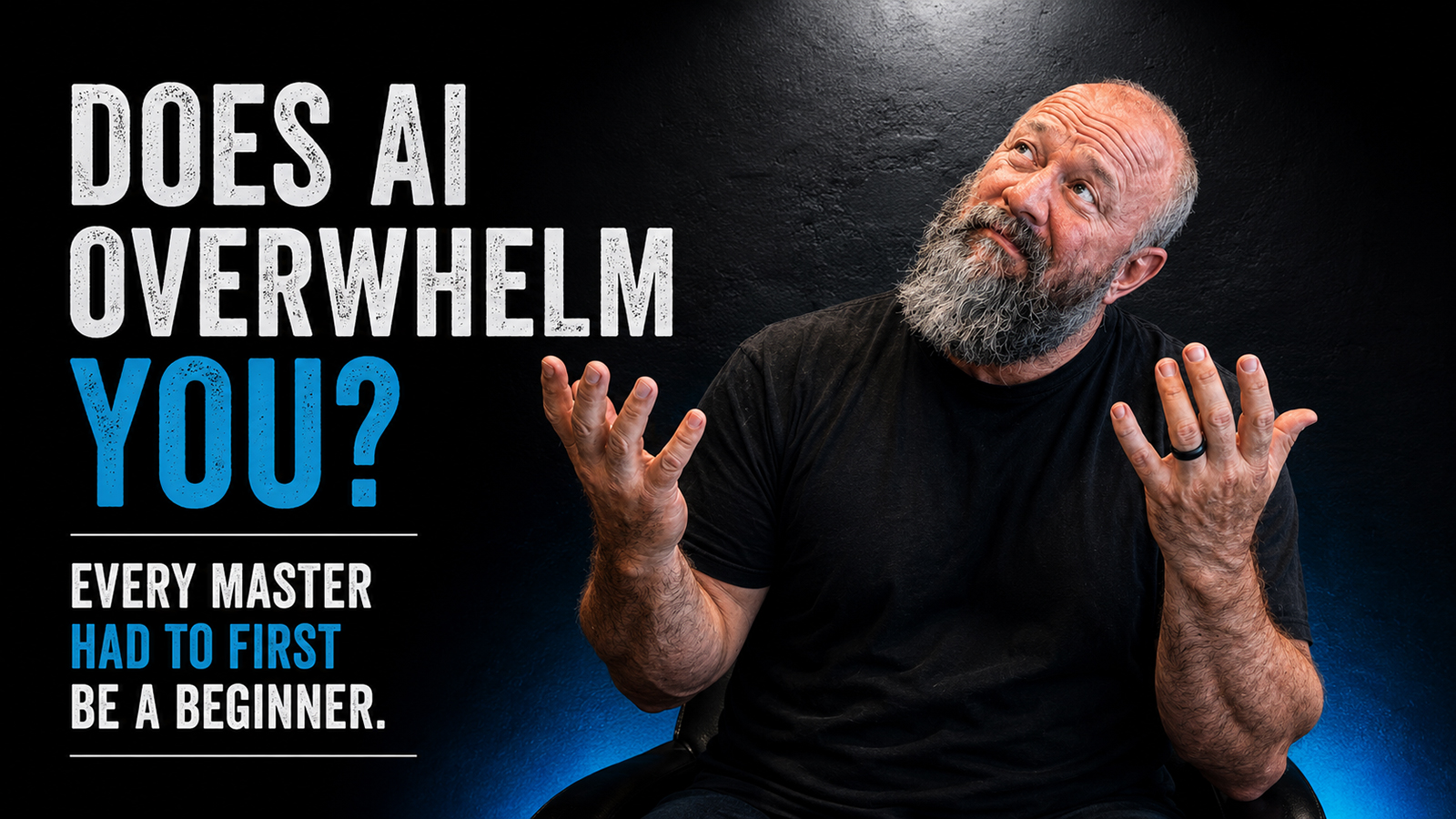
Don’t Get Left Behind
AI is already changing how people work, communicate, learn, market, build businesses, and solve problems. Most operators look at the headlines and feel like they’re already behind before they’ve even begun.
They’re not. But staying out is no longer free.
You don’t need to become an AI engineer. You don’t need to master every tool. You just need to start using one of these things — and let it compound.
A lot of people are overwhelmed because they see AI replacing jobs, building companies, writing books, generating videos, coding software, and running entire marketing systems. That picture isn’t wrong, but it’s the wrong picture for a beginner. There are levels to AI — just like there were levels to computers, the internet, smartphones, and social media. Not everyone became a programmer in the 1990s. But people who refused to touch computers eventually got pushed out of the workplace. In the early 2000s, businesses started forcing employees to use email; the ones who refused got sidelined. We’re entering that same kind of transition again, and the math of being on the wrong side of it is getting harder every quarter.
Ignoring AI completely is going to become a real disadvantage.
But there’s no reason to panic, and no reason to force yourself into systems you’re not ready for.
Start at Level 1: Have a Conversation
Most people overcomplicate AI because they immediately compare themselves to programmers or tech influencers building agent systems. That’s like walking into a gym for the first time and comparing yourself to a world-record powerlifter. You don’t start there. You start by showing up.
Open an AI tool — ChatGPT, Claude, Gemini, Grok, any of them — and just talk to it.
Ask questions. Brainstorm. Get an explanation of something you’ve been avoiding. Ask for help organizing your thoughts. That alone, done consistently, will move you further in three weeks than most people move in three years of “thinking about getting into AI.”
That’s Level 1. Almost everyone should start here.
How I Personally Started Using AI
My own entry was simple.
I’ve always loved writing. I can spend 8–12 hours a day writing with no real breaks. Writing isn’t the hard part for me — editing is. Like a lot of people, I can get thoughts out fast, but refining them, organizing them, cleaning up grammar, improving flow, making sure the message actually lands the way I intended — that’s always taken more effort than the writing itself.
That’s where ChatGPT became valuable. Not because it writes my thoughts for me, but because it helps me sharpen and refine what’s already in my head.
As a result, I publish content far more consistently now. Instead of getting stuck in endless editing or leaving projects unfinished, I focus my energy on creating. Over time, ChatGPT learned my voice, my tone, my communication style, and the way I structure ideas. From there, I started building repeatable systems — article structures, writing templates, formatting frameworks, content workflows. That changed everything. I stopped starting from zero on every piece.
AI did not replace writing. It enhanced my ability to communicate consistently.
That distinction matters. A lot of people think AI means replacing human creativity. The real power, in most cases, is amplification. It organizes ideas, improves clarity, polishes communication, removes friction. That’s why I tell people they don’t need to start with anything advanced. You can start with prompts as simple as: “Help me rewrite this.” “Help me organize this.” “Help me improve this email.” “Help me structure this article.” That alone changes how much you can ship in a week.
For me, AI started as an editing assistant. From there, it evolved into something much bigger.
What AI Can Help You With Right Now
Writing and communication
A lot of people don’t struggle because they lack intelligence. They struggle because they can’t communicate clearly. AI is incredibly good at helping you bridge the gap between what you meant to say and what actually came out — rewriting emails for tone, sharpening unclear paragraphs, making a message land more confidently or more warmly. That alone is leverage for business owners, managers, coaches, employees, parents, students, and content creators.
Learning and problem solving
AI can summarize a topic, break down a difficult concept, compare two ideas, build a study system for you, generate outlines, or brainstorm solutions to something you’re stuck on. Instead of searching through twenty websites and three YouTube videos to understand one topic, you start by asking questions.
This doesn’t mean AI is always correct. It makes mistakes — sometimes confidently. So you treat it as an assistant, collaborator, brainstorming partner, research helper — not an unquestionable authority. You still need judgment. You still need critical thinking. You still need to verify important things. But used that way, AI compounds your learning rate.
Where AI Has Taken Me Today
My use of AI has evolved well past editing. I’ve built operational systems that are helping me run the gym, organize the businesses, improve communication, create content, and revisit ventures I had previously stepped away from.
The biggest thing AI has done for me: remove bottlenecks.
For years I had more ideas than time, more systems than structure, more vision than operational bandwidth. Like a lot of entrepreneurs and gym owners, I’d hit points where execution stalled because there was only one of me. AI helped me create structure around the ideas — organize systems, build repeatable workflows, develop content pipelines, brainstorm solutions, revisit old projects with fresh perspective. Some ventures that once felt overwhelming now feel manageable, because I no longer approach them alone.
The interesting part is that these systems are learning me at the same time. They’re picking up how I lead, how I coach, how I solve problems, how I communicate, my writing tone, my decision-making patterns. Combined with consistent use over a long period, the tools begin functioning less like random software and more like operational support that understands the way I think.
They don’t replace leadership, judgment, creativity, or experience. They enhance them.
I actively use multiple AI platforms — ChatGPT, Claude, Grok, Gemini, and others. Each has strengths and weaknesses. I don’t view any of them as magic. I view them as specialized assistants and operational partners that help me move faster, think clearer, organize better, and execute more consistently. You don’t have to limit yourself to one. Different tools fit different parts of the workflow — writing, coding, research, brainstorming, organization, automation, analysis, communication, creativity. The real advantage is learning how these systems support your strengths and compensate for your bottlenecks.
For me, AI did not reduce creativity. It increased my ability to execute creative ideas consistently.
The Biggest Mistake People Make
Most people who hesitate think: “If I’m not using AI at an advanced level, there’s no point.”
That’s wrong.
Even small AI usage compounds. If AI saves you 30 minutes a day, writes a clearer email, organizes one workflow, helps you learn a skill faster, or reduces friction in something you do every week — that’s massive over months and years. Small improvements repeated consistently create disproportionate advantages.
AI Is Becoming a Competitive Advantage
Right now, a lot of people still aren’t using AI consistently. That window doesn’t last forever. AI usage will eventually become normal in business, marketing, education, customer service, healthcare, fitness, content creation, sales, operations, communication. The people learning now — even casually — are building familiarity that will matter later.
The goal isn’t to become obsessed with AI. The goal is to become adaptable.
The people who usually struggle most during major technological shifts are the ones who resist change entirely.
You Don’t Need to Be a Tech Expert
One of the biggest misconceptions is that AI is only for coders, engineers, tech companies, young people, Silicon Valley. That’s nonsense. AI is becoming useful for small business owners, coaches, gym owners, teachers, parents, tradespeople, writers, sales professionals, creative professionals, and everyday workers. The barrier to entry is lower than people think. You start with conversations. You expand from there.
Start Where You Are
You don’t need to automate your life tomorrow. You don’t need to build an AI company. You don’t need to understand machine learning models.
You need to start developing familiarity. Ask questions. Use AI to rewrite an email. Brainstorm an idea. Learn a skill. Organize thoughts. Create an outline. Improve a piece of communication. That’s enough to begin.
The people who will benefit most from AI over the next decade probably aren’t the ones trying to look the smartest online. They’re the ones who quietly integrate useful tools into their everyday work — and let the compounding do its job.
The Bottom Line
Don’t let AI overwhelm you. There are levels to this. You don’t need to master everything immediately.
But refusing to learn at all is starting to look a lot like refusing to use computers in the 1990s or refusing to use email in the early 2000s.
You don’t have to become consumed by AI. You just have to get comfortable using it.
Start with a conversation. That single step changes more than you realize.
— Dave