
The problem
You bring urgency or frustration to your AI and it amplifies it back. A decision made under a loaded frame (“act now or you lose the deal forever”) gets the same confident treatment as a calm one. Operators want to know when affect or framing may be bending how the evidence gets weighted, without the machine pretending to read minds.
What it does
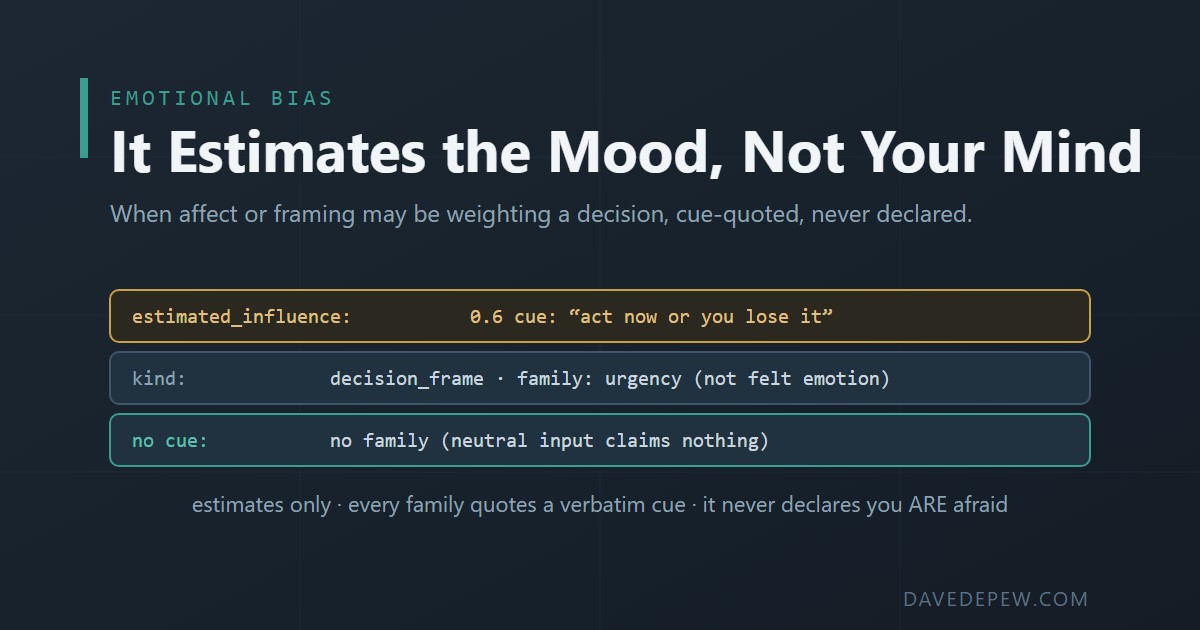
Emotional Bias estimates when affect or a decision frame may be influencing a decision. The field is named estimated_influence for a reason: it is an estimate, never a verdict. Every family it emits must quote at least one verbatim cue from the text, so you can see exactly what it reacted to. It separates felt affect from decision frames, so urgency and sunk cost are never smuggled in as emotion.
The honest part
It never declares that anyone IS afraid or angry. No cue means no family: neutral input claims nothing. The lexicons are deterministic and meant to grow from real observed misses, never from imagination. It estimates what may be leaning on a decision. It is not a manipulation detector, and it does not read minds.
Get it
Free and open source (Apache 2.0), zero dependencies, ships its own attack suite: github.com/davedepew/emotional-bias. It is one engine in The Operator’s Honesty Stack.
FAQ
Does it read emotions? No. It estimates whether affect or framing may be influencing a decision, and it quotes the cue it saw. It never asserts a feeling.
Zero dependencies? Yes. Stdlib-only, deterministic, runs offline.
Is this a manipulation detector? No. It estimates what may be leaning on your own decision, a sibling concern to detecting an AI’s influence on you.