
One Disciplined Pattern That Runs Across Every Business, Body, and Decade
The same pattern has been running underneath everything I’ve operated for nineteen years.
It runs underneath my training. It runs underneath Grinder Gym. It runs underneath the eleven divisions of Dave DePew Enterprises. It runs underneath the AI agent infrastructure I’m building right now. It ran underneath the strict curl world records. It runs underneath this article — I’m running the pattern in real time while I write about it.
For most of those nineteen years, I didn’t have a name for it. It was just how I worked. I could feel when I was on it and when I was off it, but I couldn’t have drawn it for you.
I can now.
This article names the pattern, draws it cleanly, walks through the seven steps with the discipline that belongs to each one, shows the cliff where most operators break the loop, names the only thing that unlocks the break, and ends with the pattern in your hands — ready to apply on whatever friction is in front of you right now.
Every Notebook article from here on will reference back to this one. Every operating principle I write about is another expression of the same loop running at a different scale or on a different surface. This is the article that names the substrate underneath everything else.
The Pattern
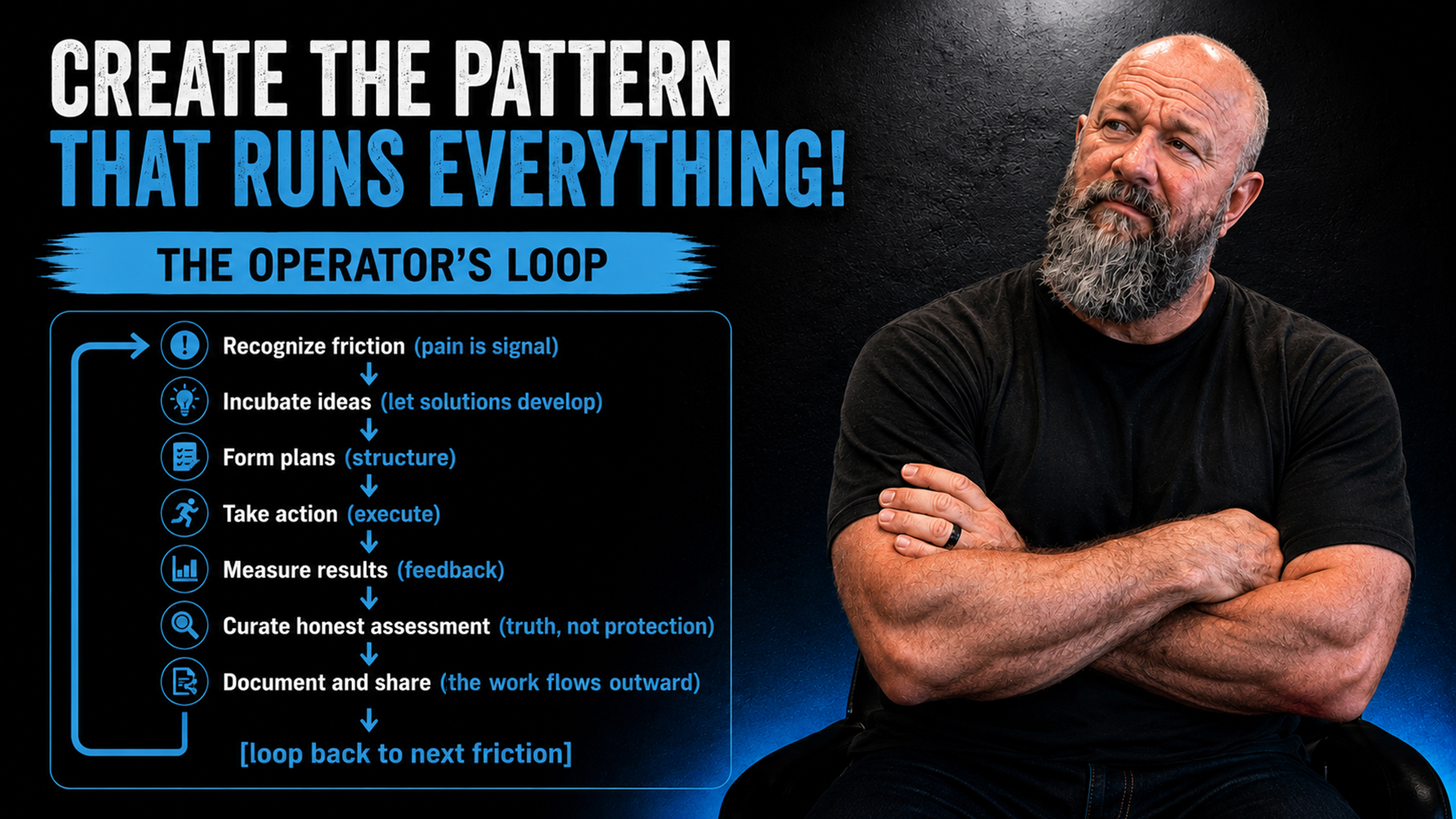
Seven steps. One return arrow:
   Recognize friction (pain is signal)
            ↓
   Incubate ideas (let solutions develop)
            ↓
   Form plans (structure)
            ↓
   Take action (execute)
            ↓
   Measure results (feedback)
            ↓
   Curate honest assessment (truth, not protection)
            ↓
   Document and share (the work flows outward)
            ↓
       [loop back to next friction]
That’s it. Seven steps. One return.
Most operators run steps one through five most of the time. The whole loop, with discipline at every step, is rare. The discipline at each step is the part most people don’t talk about — because the steps are easy to name and hard to actually run.
Let me walk each step with the discipline that belongs to it.
Step 1 — Recognize Friction
Pain is signal, not interruption. Most operators try to medicate friction (push through, distract, ignore, rationalize). The operator who runs the loop catches the pain early and reads it as data. Something here isn’t working. What is it?
The discipline at step one is refusing to suppress the signal. Most operators are good at suppressing signal. We’ve been trained to be tough, to push through, to never quit. Some of that is real virtue. The trap is that the same disposition that lets you finish a hard workout also lets you ignore the small operational pain that’s actually telling you the business is leaking.
You don’t have to act on friction at step one. You just have to admit it’s there. Step one is the moment of honesty before any plan exists. I am feeling this. It is real. It is not nothing. I am not going to numb it.
Step 2 — Incubate Ideas
Most operators jump from problem recognition directly to solution. The good operator lets ideas develop. Some friction needs three days. Some needs three weeks. Some needs a walk, a workout, a conversation with someone who isn’t trying to sell you anything.
The discipline at step two is refusing the first idea when the first idea is wrong. Your first idea is usually whatever pattern you ran last time on something that felt similar. That pattern might be the right one. It might not. Step two is where you find out before you commit.
I’ve ruined my own work by skipping step two more than once. Most expensive mistakes I’ve made were not from picking the wrong solution — they were from picking the first solution that came to mind, before I’d let the real one develop.
Step 3 — Form Plans
Structure replaces panic. Map the problem. Sequence the actions. Define what “done” looks like before you start.
The discipline at step three is being specific. Vague plans are usually unwillingness to commit to a real one. I’ll work on improving retention this quarter is not a plan. Starting Monday, every member who misses two consecutive weeks gets a personal text from their coach within 48 hours, and I’ll review the spreadsheet of who got contacted every Friday is a plan.
If your plan can’t be checked by another operator looking at it, it isn’t a plan. It’s a wish.
Step 4 — Take Action
Execute. Not perfectly. Not when conditions are right. Now.
The discipline at step four is starting before the readiness feeling shows up. For most operators, the readiness feeling never shows up. The operators who appear to have it are the ones who started without it and got readiness on the back end through the doing.
The other discipline at step four is starting small enough to actually run. Most operator paralysis is because the plan is too big to start. Cut the plan into the smallest version that still moves the needle. Do that version this week. Don’t wait until you can execute the whole plan.
Step 5 — Measure Results
What actually happened? Did the action move the metric you said you were going to move?
Don’t measure with vibes. Measure with numbers, dates, retention, revenue, completed reps, response times — whatever the unit of truth is for this friction.
The discipline at step five is choosing the metric in advance, so you can’t pick a flattering one in retrospect. If you choose the metric after the action, you’ll choose the one that makes you look right. That’s not measurement. That’s narrative protection.
Step 6 — Curate Honest Assessment
This is where most operators break.
We’ll come back to it — the next section is dedicated to step six because it’s the cliff the whole loop lives or dies on.
Step 7 — Document and Share
Write down what happened. Send it outward. Teach it. Publish it. Hand it to the next operator who’s about to make the same mistake you almost made.
The discipline at step seven is refusing to keep what worked private — because what stays private dies with the operator. The methodology I’ve been running at Grinder Gym for nineteen years would have died inside the building if I hadn’t started documenting it. Most of what other operators in my space know how to do will die with them because they never wrote it down. That’s the cost of skipping step seven.
Step seven is also the discipline of generosity. You don’t document for credit. You document for service. The next operator coming up behind you doesn’t owe you anything for the documentation. The documentation is the gift.
Then the return arrow runs you back to step one — usually because solving one friction surfaces the next one. The work compounds. The operator compounds. The body of documentation compounds. After ten or fifteen revolutions, you can’t be replaced by anyone reading you — because you ran the loop and they’re still figuring out how to start.
Why Most Operators Break the Loop at Step 6
The loop has one cliff. It’s step six — honest assessment.
Steps one through five most operators can run. They feel pain. They have ideas. They make plans. They execute. They look at outcomes. Where most operators stop is at the moment of telling the truth about what they saw.
Ego protects the prior decision. The operator who spent six weeks running a marketing campaign that didn’t work has a strong incentive to not see clearly that it didn’t work. They’ll find another metric. They’ll blame the season. They’ll change the goalpost. They’ll say we needed more time or the audience wasn’t right or the launch was a learning experience. They’ll do anything except look at the outcome and say: that decision was wrong, here’s the data, here’s what I’m doing differently.
That’s the cliff.
The whole loop stops compounding the moment step six breaks. You can run steps one through five forever and never get smarter, because step six is where smart actually accumulates. Smart is not a function of how many decisions you make. Smart is a function of how honestly you assess the decisions you already made.
The discipline that unlocks step six is what I call ego death.
Ego death doesn’t mean self-hate or self-erasure. It means refusing to defend the identity that was attached to the prior decision. The operator I was six weeks ago made a decision based on what they knew at the time. Today’s operator has six weeks more data. There’s no shame in the older self being wrong. The only shame is the older self refusing to be wrong.
Ego death is what lets step six actually run honestly. Without it, the loop is a five-step performance — looking like an operator who learns without actually learning.
The same disposition operates differently at other steps too:
- At step 1, ego refuses to feel the friction — because feeling it would mean admitting something isn’t working
- At step 4, ego refuses to start — because starting risks failing, and failing threatens identity
- At step 6, ego refuses honest assessment — because the truth might require dropping the prior decision and the identity attached to it
- At step 7, ego refuses to share publicly — because sharing means other operators see what didn’t work, and that risks exposure
Same ego. Four different places it can break the loop. The operator who runs the full loop has practiced dropping ego at all four points. Not just once — at every revolution.
Ego isn’t the only thing that breaks the loop, either. Look closely and you’ll see four related but distinct disruptors operating at different steps:
- Ego interrupts observation — you don’t see what you don’t want to see
- Identity blocks assessment — you can’t admit the data because of who you’d have to become if it were true
- Insecurity distorts interpretation — you read every signal through the lens of the threat to your sense of self
- Pride prevents adaptation — you refuse to change because changing means the previous version of you was wrong
Same family of disruptors. Slightly different operating mechanisms. All four shut down some part of the loop. Naming them helps you catch which one is running on you in any given revolution. The operator who can name which ego mode is breaking the loop right now has a faster recovery than the operator who only knows “something’s off.”
This is also why most coaching content can’t make people better operators. It teaches the steps but not the disposition that runs them. The steps are public. The ego work is private. Most people will read step six and nod along and then go right back to defending their prior decision in real life. The steps are easy. The ego death is the work.
Scale Invariance — The Same Loop Runs at Every Scale
The pattern doesn’t only run on small frictions. It runs identically at every scale of operation. Same shape, different scope. That’s the most important property of the loop to understand — and the property most operators miss, because they only ever see it operating at one scale at a time.
Let me show you the same loop running at seven different scales of my own work, in the same week.
Personal Scale — The Strict Curl
The strict curl is one of the most unforgiving lifts in strength sport. The body is locked against a vertical surface. There’s no kip, no body english, no momentum. You either move the weight in clean position or you don’t.
That practice has been a daily loop for me for two decades. Friction — a weight I can’t move cleanly. Incubate — what’s actually limiting it (mobility, grip, neural drive, recovery, technique, breath, focus).
Plan — adjust one variable.
Action — train it.
Measure — does the weight move cleanly this week.
Honest Assessment — what did I actually feel during the lift; what would I do differently next session.
Document — log it in the training journal. Loop.
The lifts that became world records weren’t different from the lifts that didn’t. They were the same loop run thousands of times. The reps were never the point. The loop was the point. World records are an artifact of the loop running long enough.
Operational Scale — Grinder Gym Retention
I shipped an article last week on knowing your churn rate. That article exists because the loop ran at the gym.
Friction — members were leaving and I couldn’t tell you exactly why.
Incubate — I sat with the question for weeks before doing anything.
Plan — start tracking cancellations, failed payments, average client lifespan, retention by coach, retention by source, the first 30 days.
Action — instituted the tracking system; reviewed the numbers with my coaching team every Friday for a full quarter.
Measure — the actual data: month-over-month churn rate, average client lifespan, retention variance by coach, retention variance by acquisition source.
Honest Assessment — the math was uglier than the vibes had been telling me. The gym felt busier than the bank account was telling me it was.
Document — that article is the documentation.
The loop ran on a single operating friction; the article is the output of step seven.
The loop didn’t end there. The article surfaced the next friction — predictive retention, flagging at-risk members before they cancel rather than after. That’s the next revolution. The Notebook will document that one too. That’s how the loop compounds: one revolution surfaces the next friction; the documentation makes the surface visible to the operator AND to every reader who recognizes the same pattern in their own operation.
The unlock at this scale is simple to name and hard to live: operational friction becomes intelligence when honestly assessed. Most gyms have the friction. Most gyms don’t have the intelligence. The difference is step six.
Organizational Scale — Dave DePew Enterprises
The eleven divisions of Dave DePew Enterprises are not a business plan written on a whiteboard one weekend. They’re the result of the loop running at organizational scale across the last several years.
Friction — I have more operating capability than I can fit into Grinder Gym alone.
Incubate — what are the natural divisions, what verticals does my actual experience cover, where could the work go without me needing to be in every room.
Plan — architect eleven divisions with clear boundaries and a sequence of build priority.
Action — start building, one at a time, beginning with what’s already proven (the gym, the coaching, the content, the AI infrastructure).
Measure — which divisions show real pull, which ones are aspirational.
Honest Assessment — am I building from genuine capability or from ambition.
Document — the corporate charter exists; future operators can read it; this article is part of the documentation layer too.
The loop is still running. New divisions will surface as the loop runs. Some early divisions may not survive an honest assessment. That’s not failure. That’s the loop working.
Systemic Scale — The Agent Fabric
There’s a version of this loop running at system scale right now. It’s the rule that governs how new capability enters the AI agent fabric I’m building:
Friction → Idea → Fix → Skill → Tool → Service → Role → Named Agent
That’s the same loop. Recognize a capability gap (friction). Sketch a solution (idea). Implement it as a Fix. Generalize the Fix into a reusable Skill. Promote stable Skills to Tools. Compose Tools into Services. Define Roles that consume Services. Promote a Role to a Named Agent when it earns the seat.
Same loop. Different vocabulary. Different scope. Identical mechanics.
The pattern doesn’t know if you’re looping a personal lift or an entire AI subsystem. The shape is the same. That’s the whole point of recognizing a scale-invariant pattern: once you can see it at one scale, you can see it at all of them. And once you can see it at all of them, you can run it deliberately at each one — instead of only at the one you happen to be focused on this week.
The Operator’s Loop is not just philosophical. It’s architectural. I’m not describing a mindset. I’m describing the structural shape that capability has to take in order to compound. The AI agent fabric runs on the same architecture as my training journal. The eleven divisions of DDE Inc. run on the same architecture as a single coaching client engagement. The shape is the substrate. The substrate is the brand.
Content Scale — This Notebook
The Notebook itself is the loop running at content scale.
Friction — operators in my space need real operational thinking, indexed for years of reference, and they’re not getting it. The internet is full of motivation; the operators behind the operators need something different.
Incubate — what would the actual depth look like; who is it for; what voice; what cadence.
Plan — three pillars, weekly cadence, four-test content standard (hook + over-deliver + implementation surface + canonical-resource posture).
Action — ship the first articles weekly on Sundays.
Measure — which articles get cited and referenced by other operators, which DMs come in, which sections get quoted back, what the analytics show for time-on-page and return reads.
Honest Assessment — what worked, what didn’t, what was a vanity choice.
Document — this article is step seven running on the Notebook itself. Loop.
Lifetime Scale — The 19-Year Operator
Across nineteen years of operating Grinder Gym, the loop has run at the largest scale available to me — the scope of a working life.
The friction I started with was simple: I wanted a place to train hard, with people who took strength seriously, that didn’t look like a commercial gym. The loop has been running on that friction for nineteen years. Every five years has been a full revolution at a wider scope. Every one of those revolutions added something — coaches, equipment, members, methodology, brand, business architecture, infrastructure, documentation.
I’m still on the loop. The current revolution is documented publicly across these surfaces: Notebook, Stack, Show, davedepew.com, Grinder Gym itself, the agent fabric. Nineteen years of implementation; now nineteen years of documentation getting caught up.
Right Now — This Article
The most concrete worked example I can give you is the article you’re reading.
The friction was that the philosophy underneath everything I operate was implicit, not articulated. Across an extended working session, I ran the loop on the philosophy itself. Recognize → incubate (lots of incubation, several conversations) → plan (the seven layers of the operator pattern) → action (the meta-document filed publicly) → measure (does the stack hold together when stressed against external frameworks from nine different mentors) → honest assessment (one structural conflict caught and reframed, one strategic insight surfaced about pattern interrupts) → document (this article).
This article is step seven. While I was writing about the loop, the loop was running.
The article itself is proof of the concept the article is explaining. If the loop didn’t work, the article wouldn’t exist.
Where I’ve Broken the Loop
The honest assessment discipline cuts both ways. If I’m going to write about it, I should show you where it broke for me — not as confession, but because modeling honest assessment is the only way to teach it.
Where step 1 broke for me. I spent years not naming the friction in the gym’s retention numbers. I had a sense something was off. The bank account was tighter than the floor was busy. I medicated that signal with more marketing instead of reading it as the retention problem it actually was. Step one — recognizing the friction honestly — would have saved me thousands of dollars in unnecessary lead acquisition and probably a couple of years of unnecessary stress.
Where step 6 broke for me. There were programming decisions I defended longer than I should have, because I was the one who made them. A few years where I held onto a coaching pricing structure that wasn’t producing the right client — because admitting it would have meant admitting I’d been undercharging the right operators while overcharging the wrong ones. Step six finally ran. The pricing structure changed. The clients changed. I should have run step six two years earlier than I did.
Where step 7 broke for me. I’ve been operating in public for nineteen years but not documenting in public for nineteen years. The Notebook is me catching up on step seven. There are systems, methodologies, frameworks, and operating principles I’ve been running internally for over a decade that I’m only now writing down. The loss isn’t to me — I have them in my head and in my operation. The loss is to every operator who would have benefited from them and didn’t have access. Step seven is generosity at scale. I owed it earlier than I delivered it.
Three operators reading this will recognize themselves in one of those three breaks. The break isn’t shameful. The unwillingness to look at the break is shameful.
The Reader’s Takeaway — Run the Loop on What’s in Front of You
Pick a real friction. Not a hypothetical. Something that’s actually live in your operation right now. A retention problem. A client you should have fired three months ago. A revenue ceiling you can’t see past. A decision you’ve been postponing. A coach who isn’t growing. A program you launched that didn’t land.
Walk it through the loop:
- Recognize. Name the friction specifically. Not “marketing isn’t working” — lead-to-tour conversion has dropped 40% since November and I haven’t named it out loud. The specificity matters more than the answer.
- Incubate. Give yourself three days minimum. Sit with the problem. Don’t jump to the first fix. The first fix is usually a way of avoiding the harder fix. If you find yourself already moving toward action, slow down — incubation is the discipline of not moving.
- Plan. What’s the structured intervention? What’s the one variable you’re changing? What does “done” look like in 30 days? Write the plan in language another operator could check.
- Action. Start before you feel ready. The feeling never arrives on schedule. Cut the plan small enough to start this week.
- Measure. Pick the metric before you start. Honest metrics; ones that can show you were wrong. Write the metric down somewhere you can’t quietly change it later.
- Honest Assessment. This is where the loop lives or dies. What actually happened. What did the data say. What would I do differently. What am I unwilling to admit because it would mean dropping a prior decision. Where am I lying to myself right now about this work. Sit with those last questions for as long as it takes. If nothing surfaces, you haven’t sat with them long enough.
- Document and Share. Write down what you learned. Send it to one other operator who’s facing something similar. Don’t paywall it. Don’t make them earn it. Just give it.
Then the return arrow runs. The friction you solved surfaces the next one. The loop continues.
Do that on one friction this month and you’ll move further than most operators move in a year. Do it on every friction for nineteen years and you’ll have built something most operators can’t replicate, because it can’t be copied — it has to be lived.
Ask yourself the harder questions before you close the laptop:
- Where is my loop breaking right now?
- Where am I avoiding friction I already know is there?
- Where am I lying to myself about what the data is saying?
- Where is growth available immediately if I just told the truth?
The operators who get to year nineteen are the ones who sit with those questions every quarter. The ones who don’t make it that far are the ones who never ask them.
The Pattern Is the Product
Most operators try to build a business that produces a service or a product. The deeper move is to build a business whose product is the disciplined pattern itself — and let the artifacts the pattern produces be the proof.
The pattern is the product. The implementations are the proof. The documentation is the brand.
Run the loop honestly, at every scale you operate at, for long enough, and the artifacts compound past anything any single product could produce. Strict curl world records compound. Nineteen years of gym operation compound. Eleven business divisions compound. An AI agent fabric compounds. A Notebook compounds. The operator compounds.
The operator who runs the loop at every scale, for a working lifetime, with ego death at the steps where the loop breaks, ends up with something most coaching content cannot produce: a body of real work that documents itself.
Use yourself up doing it.
Let there be nothing left when your time comes.
— Dave