
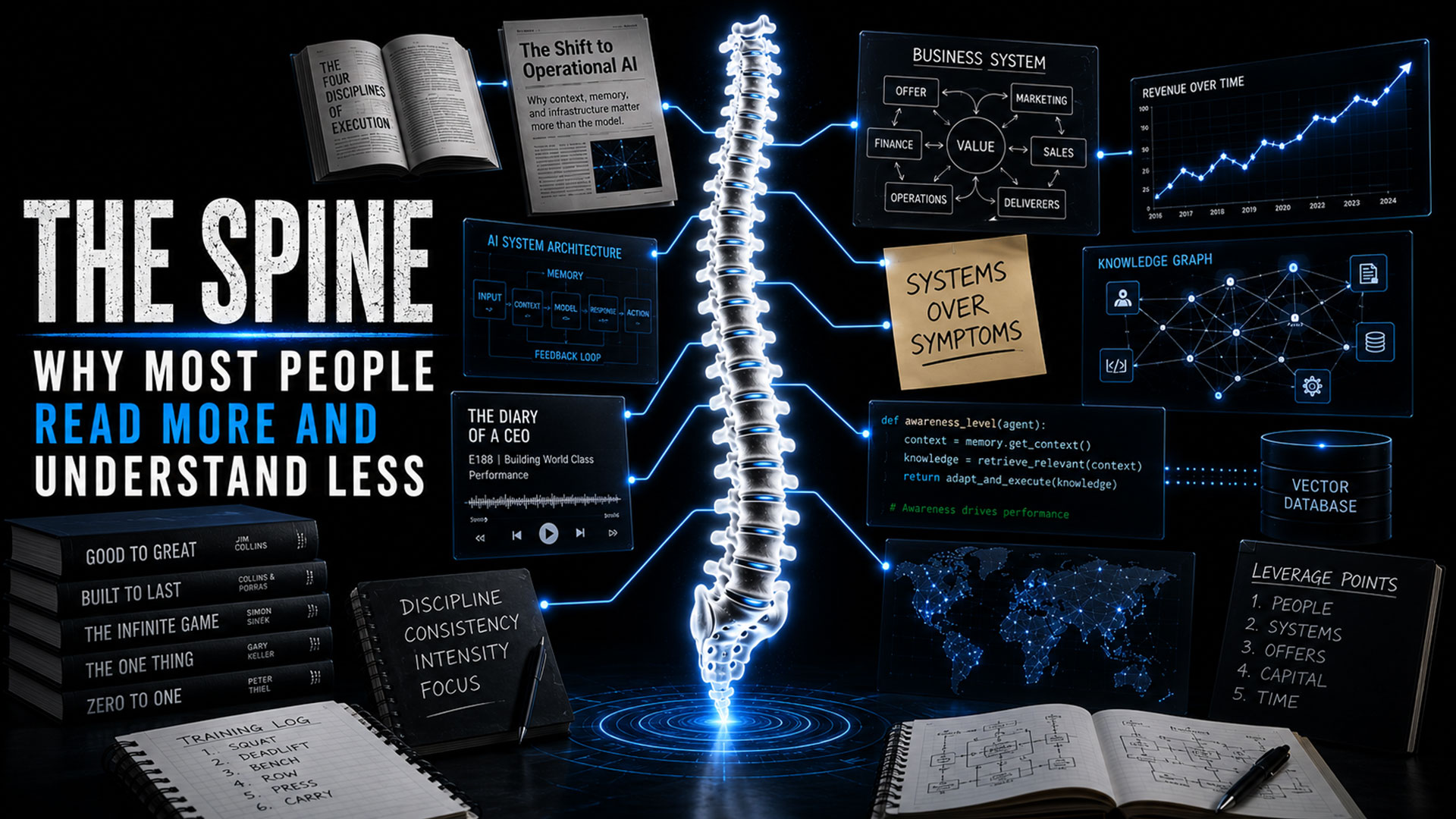
Why Most People Read More and Understand Less
Every day we’re surrounded by information.
Articles.
Books.
Podcasts.
Videos.
Social media posts.
Courses.
Most people consume them.
Few people understand them.
The difference is rarely intelligence.
The difference is structure.
Years ago I realized that when I finished reading many books, I could remember dozens of facts but couldn’t explain the actual point.
I knew the details.
I missed the architecture.
Then I started asking a different question:
“What is the spine?”
Not the examples.
Not the stories.
Not the statistics.
Not the conclusions.
The spine.
The central idea that everything else is attached to.
Once you find the spine, everything changes.
A hundred-page book becomes one sentence.
A two-hour podcast becomes one idea.
A business becomes one operating principle.
A person’s behavior becomes one driving belief.
Suddenly complexity becomes manageable.
The Human Brain Loves Details
The brain naturally pays attention to what is interesting.
Stories.
Conflict.
Novelty.
Emotion.
That’s useful.
It’s also dangerous.
Because the thing that captures attention isn’t always the thing that creates understanding.
Most people remember the story.
Few remember the lesson.
Most remember the quote.
Few remember the principle.
Most remember the tactic.
Few understand the system.
This is why people can consume endless information and still feel confused.
They are collecting branches while missing the trunk.
Every Great Idea Has a Spine
Every strong article has one.
Every successful company has one.
Every movement has one.
Every philosophy has one.
The spine is the answer to a simple question:
“If I removed everything except one sentence, what sentence must survive for the entire thing to still mean the same thing?”
That sentence is usually the spine.
Everything else exists to support it.
Examples support it.
Evidence supports it.
Stories support it.
Frameworks support it.
Without the spine, they’re disconnected pieces.
With the spine, they become a system.
Why This Matters For Business
Business owners often make the same mistake.
They focus on activities instead of principles.
They chase tactics instead of understanding the system.
They see marketing campaigns.
They see sales scripts.
They see AI tools.
They see software.
But they miss the spine underneath.
The best operators are always looking for the spine.
The principle.
The lever.
The thing that makes everything else work.
When they find it, decisions become easier.
Because they understand the system instead of reacting to the symptoms.
This Is How I Learn
When I read something, I don’t ask:
“What does this say?”
I ask:
“What is this really about?”
When I study a business, I don’t ask:
“What do they do?”
I ask:
“What belief drives everything they do?”
When I look at an AI system, I don’t ask:
“What model are they using?”
I ask:
“What is the architecture underneath the intelligence?”
Different questions produce different awareness.
Different awareness produces different decisions.
Different decisions produce different outcomes.
The Real Skill
The ability to find the spine is one of the most valuable skills you can develop.
Because once you can see the spine, you can see the structure.
Once you can see the structure, you can improve it.
Once you can improve it, you can build better systems.
Whether you’re studying business, leadership, fitness, technology, relationships, or artificial intelligence, the question remains the same:
What is the spine?
Find that.
Everything else starts making sense.